

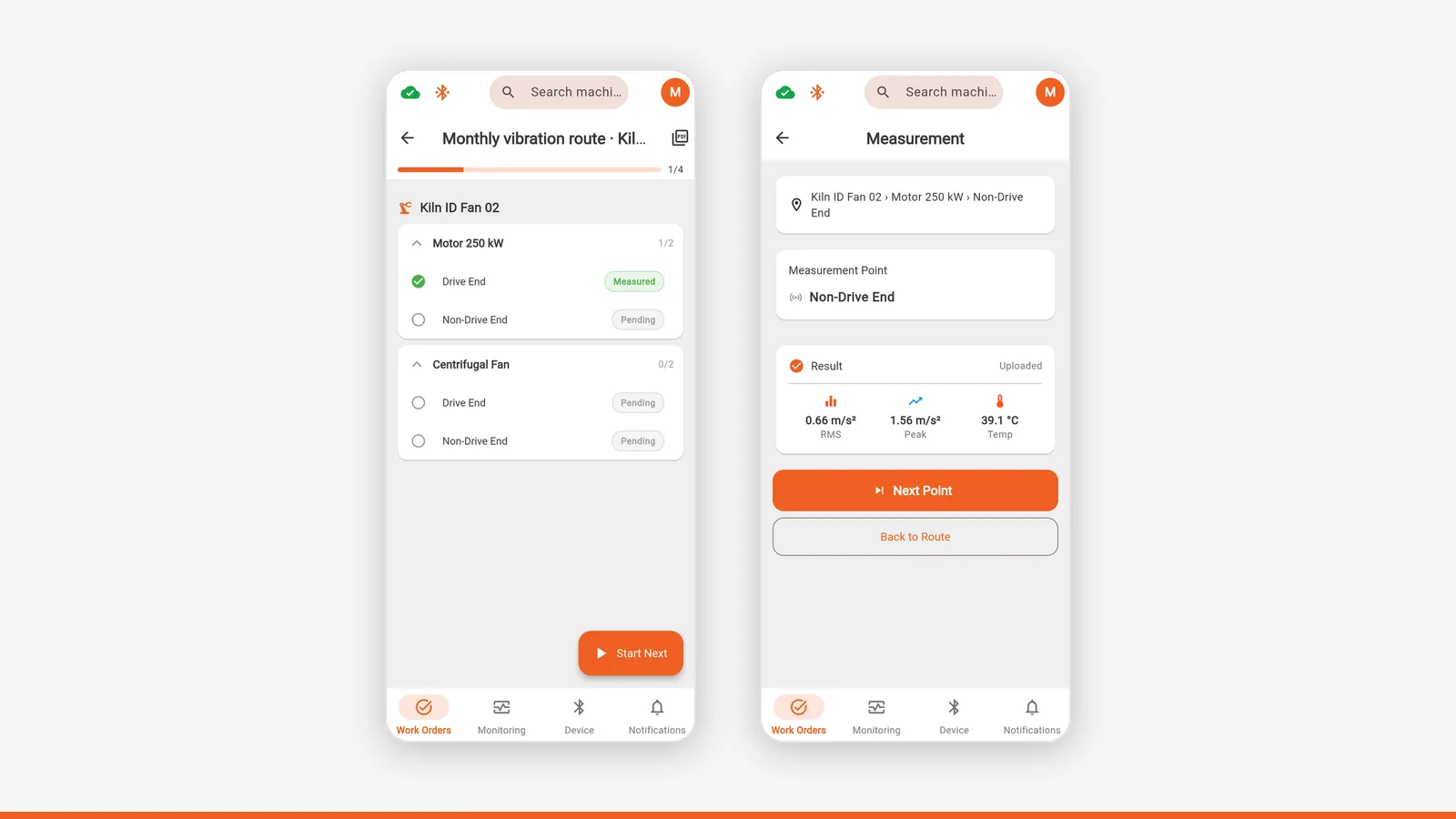
A route work order now carries the measuring points the planner picked, and Sensemore On Field walks exactly those points. The operator connects an Infinity over Bluetooth, takes a reading at each stop, and the round closes when the picked points are done. Readings carry the time they were taken, so a walk through a plant with no coverage still lands on the trend at the right hour.
The Planner Owns the Route
A work order of type route-based vibration points at one machine train and carries its own list of measuring points. The create form offers the machine’s places, filtered to the ones that accept an accelerometer: a motor’s drive end and non-drive end are on the list, its junction box, which takes an ammeter, never is. Select all takes the whole machine.
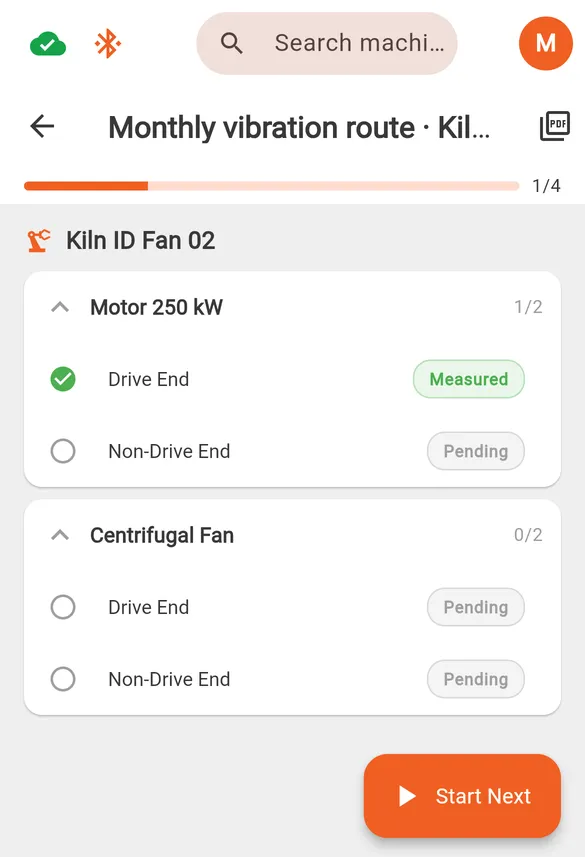
The reason the round is picked rather than derived is a practical one. A place behind a guard that comes off only at shutdown belongs to the machine but not to this month’s walk, and a round nobody can finish is a work order nobody can close. What the planner picks is what the phone counts.
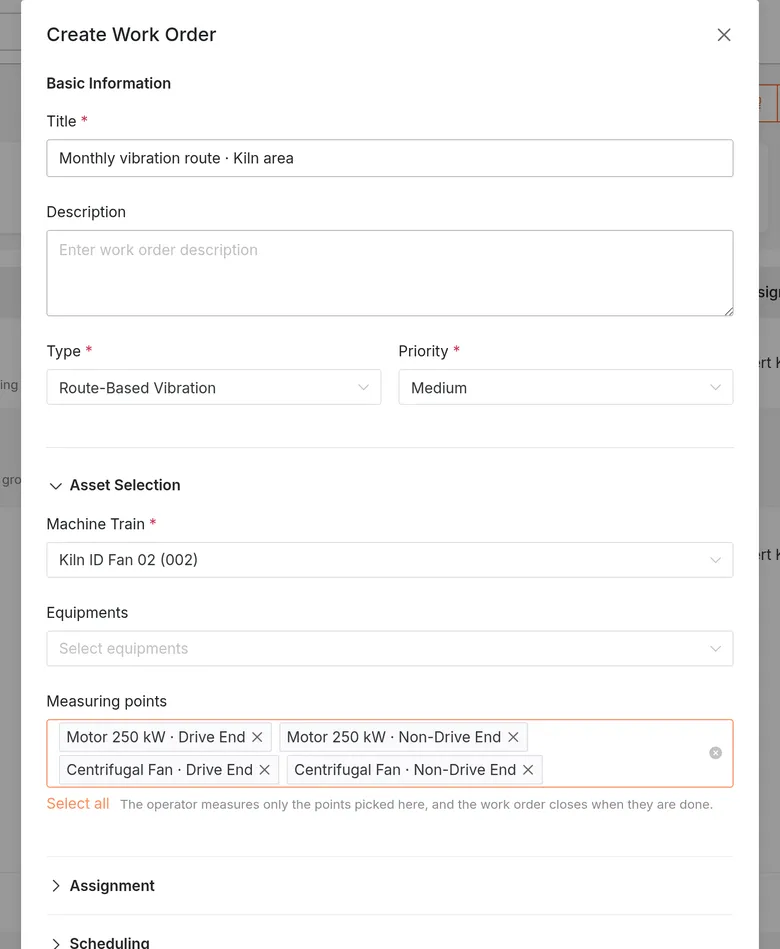
A preventive maintenance schedule can carry the same list, so a monthly round is raised with its route already pinned. A schedule with no list raises a round that walks the whole machine, which is what a route meant before.
The Walk
Progress lives on the work order rather than on the phone, so a round survives a flat battery, a shift change and a second operator: whoever opens it next sees the points already measured and continues from there.
At a point, the app names the machine, the equipment and the place before anything starts, so the sensor can be checked against the right bearing. Start Measurement then writes the configuration to the sensor, waits for it to finish, reads the samples back, crops them with the sensor’s own calibrated sampling rate rather than the nominal one, and computes RMS and peak alongside the bearing temperature the sensor reports.
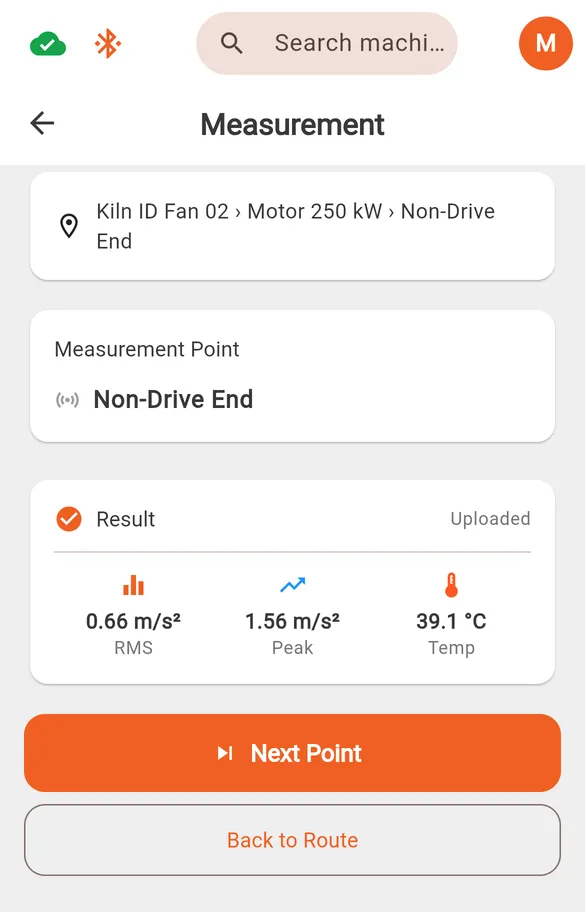
The card reports the reading and passes no verdict. The criteria a plant judges by are the thresholds held per measuring point in LAKE, not two numbers held in a phone, and a reading taken somewhere off the route is still stored as a measurement; it simply does not move a round it was never part of.
What Reaches the Platform
Each point is one upload. It carries the samples of every axis in g, the sensor’s calibrated sampling rate and range, the temperature, the point it belongs to and, most importantly, the time the reading was taken.
In LAKE the measurement is written with the raw waveform per axis, temperature and an RMS value appear on the trend immediately, and the signal then goes through the same validation and telemetry calculation as any other. From there it is an ordinary measurement: the same trends, the same threshold alarms, the same health assessment.
That taken time now follows the reading all the way down. Bearing scores and structural fault scores used to be stamped with the moment the phone found signal again; since 17 September they are stamped with the moment the reading was taken, which is what makes a backdated walk trend correctly.
Getting the App
The app is handed out by the platform rather than by a store. Settings, then Preferences, then On Field App shows the published version, its size and its date with a download button. A build copied onto the server is live immediately, and everyone who can log in can reach it, since the operators who need the app are the ones with the fewest rights.
Frequently asked questions
What is a route work order?
A work order of type route-based vibration, raised against one machine train, that carries its own list of measuring points. The planner picks those points on the create form, and only places that accept an accelerometer are offered, so a motor's junction box is never on a vibration round. The list is the route: the phone walks those points and nothing else, and the count the operator sees is the count the planner picked.
Which sensor takes the reading?
A Sensemore Infinity, connected over Bluetooth from the phone or tablet. The connection is made once and held for the whole round, so every point after the first is a tap. The same upload path also accepts the three line currents of a handheld clamp meter, which is how a current reading taken on a walk reaches the MCSA analysis.
What happens where there is no signal?
The round still works. Work orders and machine hierarchies are cached before the walk, so the route opens and lists its points offline, and an upload that cannot reach the platform is queued on the device with its full payload while the operator carries on. The queue replays in order when connectivity returns. Because every reading carries the time it was taken, a route walked at six in the morning and synced at noon lands on the trend at six, not at noon.
Is a walked reading treated like one from a permanently mounted sensor?
It goes through the same pipeline: the raw signal is stored and validated, the telemetry engine calculates from it, and trends, thresholds and alarms treat it exactly as they treat a fixed sensor's reading. The scores that depend on running speed, which are the bearing scores, the structural fault scores and S-Mode, need what they always need: an enabled speed prediction model for that point, bearing specifications on the equipment, and three axes for the structural ones.
How do operators get the app?
From LAKE itself. Settings, then Preferences, then On Field App shows the current version, its size and its publication date with a download button, and everyone who can log in can see it, because the people who need the app are the ones with the fewest rights. It is an Android build installed from the downloaded file rather than from a store.