

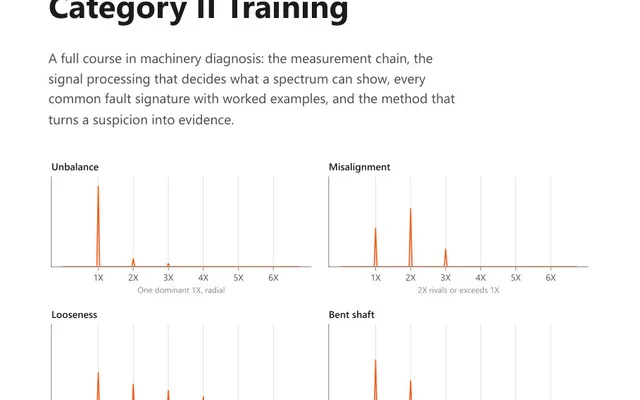
Vibration Analysis Training: Category II
An 88-page course book on vibration diagnosis: which fault produces which pattern, what phase adds, and how to disprove an answer before reporting it.
Enter a broadband RMS velocity reading with the machine group and the support class, and the calculator places it in an ISO 20816-3 evaluation zone and, if a previous reading is given, tests the change against the standard’s own criterion. The boundaries are those of ISO 10816-3, which ISO 20816-3 carries forward.
The standard does not grade a machine as good or bad. It puts a reading in one of four zones, each of which is a statement about what running the machine in that state costs you.
| Zone | What it means |
|---|---|
| A | The range for newly commissioned machines. |
| B | Acceptable for unrestricted long-term operation. |
| C | Unsatisfactory for long-term continuous operation. The machine may be run in this condition for a limited period, until an opportunity arises for remedial action. |
| D | Severe enough to cause damage to the machine. |
Zone C is the one that gets misread. It is not an instruction to stop the machine, and it is not permission to ignore the reading either. It says the clock has started: plan the work for the next opportunity rather than the next shutdown after that.
There is no single set of limits to look up. There is a grid, and a reading has to be placed in the right cell of it before any number applies at all.
Both axes move the numbers, and they move them a long way. The same 3.2 mm/s RMS is zone C on a medium machine mounted rigidly and zone A on a large machine mounted flexibly. Anyone who quotes a severity limit without naming the group and the support class has quoted half a limit.
The boundary values themselves are not reproduced on this page. Choose the group and the support class in the calculator and it returns the two your reading sits between, which is the part of the grid that bears on the machine in front of you. For anything wider than that, keep a copy of the standard to hand. It is the authority on the numbers and on which group a machine belongs to, and that second judgement is a reading of the standard’s own definitions that no calculator can make for you.
The classification is not about how heavy the baseplate looks. The support is rigid when the lowest natural frequency of the machine and support system, measured in the direction the reading is taken, is at least 25 per cent above the main excitation frequency, which on most machines is running speed. Below that margin the support is flexible.
The margin is the part that gets dropped, and dropping it changes the answer. A natural frequency sitting a hair above running speed does not make a rigid support; the standard asks for a clear quarter above it. The direction matters too, because the same machine can be rigid horizontally and flexible vertically.
That is a measurable thing rather than a matter of opinion: a bump test or a coast-down will tell you. It is worth settling once per machine and recording, because the difference between the two classes is large enough to move a reading two zones.
The zones apply to a specific quantity, taken in a specific way:
A reading taken over a different band, or on the shaft rather than the housing, is not the quantity these zones evaluate. This matters more than it sounds. A route configured with a 2 Hz to 2000 Hz overall will read higher than one configured to the standard band on the same machine, and comparing it against these boundaries quietly moves every machine on the route towards a worse zone.
Where a machine builder states its own limits, or a contract does, those take precedence over the standard values. The standard says so itself.
The zone is only half the evaluation. A change of more than 25 percent of the upper boundary of zone B is significant under the standard, in either direction.
Both directions matter. A machine whose vibration has halved has changed as much as one that has doubled, and the reason is worth knowing: a shifted alarm band, a sensor mounted somewhere new, a process change, a coupling that has finally seized rather than a fault that has healed.
A 75 kW motor driving a fan, mounted rigidly. That puts it in the medium machine group. Today’s reading is 3.2 mm/s RMS.
Enter the reading with that group and that support class. The calculator places it in zone C and shows the two boundaries it sits between: unsatisfactory for long-term continuous operation, run it to the next opportunity and fix it there.
The previous route reading at the same point was 2.1 mm/s RMS. The change is 3.2 minus 2.1 = 1.1 mm/s, or 52 percent of the old value. The significance threshold is a quarter of the upper boundary of zone B for that particular machine. Take that boundary as 2.8 mm/s purely to show the arithmetic, and the threshold is 0.25 × 2.8 = 0.7 mm/s. The change is larger than that, so it is significant, and the machine is not simply sitting where it has always sat.
Had the same 3.2 mm/s come from a 4 MW machine on a flexible foundation, the boundaries for that combination would be higher and the same reading would fall in zone A. The number on the meter is not the finding. The number, the machine and the mounting together are.
There is no single acceptable level, which is why one cannot be quoted. The standard sorts machines into groups by size and type, splits each group by whether the support is rigid or flexible, and gives every combination four evaluation zones, A to D. The boundaries rise with machine size and rise again on a flexible support, so a level that is zone A on one machine is zone C on another. Enter the reading with the group and the support class and the calculator returns the zone for that case, with the two boundaries the reading sits between. The standard is the authority on those values and on which group a machine belongs to.
Zone A is the range expected of newly commissioned machines. Zone B is acceptable for unrestricted long-term operation. Zone C is unsatisfactory for long-term continuous operation, though the machine may be run in that condition for a limited period until an opportunity arises for remedial action. Zone D is severe enough to cause damage to the machine. The zones evaluate broadband vibration severity, not the cause of it.
For the purpose of judging a broadband velocity reading, nothing that changes the answer. ISO 20816-3 carries forward the evaluation zone boundaries of ISO 10816-3, so a measurement placed in zone B under the older reference lands in zone B under the newer one. A machine builder's own limits, or limits written into a contract, take precedence over the standard values in either case, and the standard says so itself.
The support counts as rigid when the lowest natural frequency of the machine and support system, in the direction the reading is taken, is at least 25 per cent above the main excitation frequency, which on most machines is running speed. If it is not, the support is flexible. The margin is part of the definition: a natural frequency sitting a hair above running speed does not make a rigid support. The distinction matters because the allowed limits are markedly higher on a flexible support, so getting it wrong in either direction produces the wrong verdict from a perfectly good reading.
A change of more than 25 percent of the upper boundary of zone B is significant, and it counts whether the level has risen or fallen. The threshold is therefore a property of the machine rather than a fixed number of mm/s: it moves with the machine group and the support class, and the calculator works it out once both are chosen. A reading that climbs from well inside zone B to the top of zone B is still acceptable in absolute terms and can still have changed by enough to be worth investigating, which is exactly the finding a pass/fail check throws away.
The calculator gives you the number. These course books explain what the number means and how the measurement that produced it should be taken.
An 88-page course book on vibration diagnosis: which fault produces which pattern, what phase adds, and how to disprove an answer before reporting it.
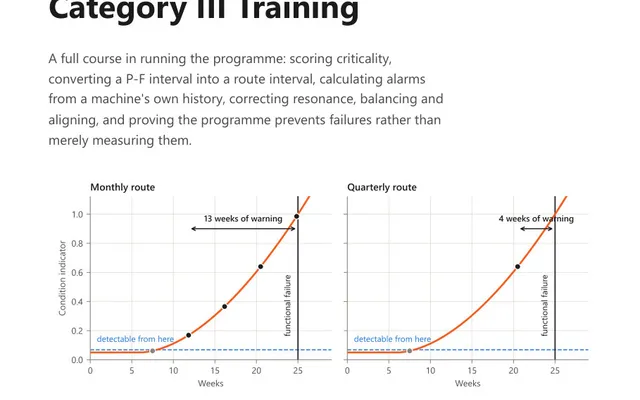
A 56-page course book on running the programme: criticality scoring, the P-F interval, and alarms calculated from the machine's own history, not a table.
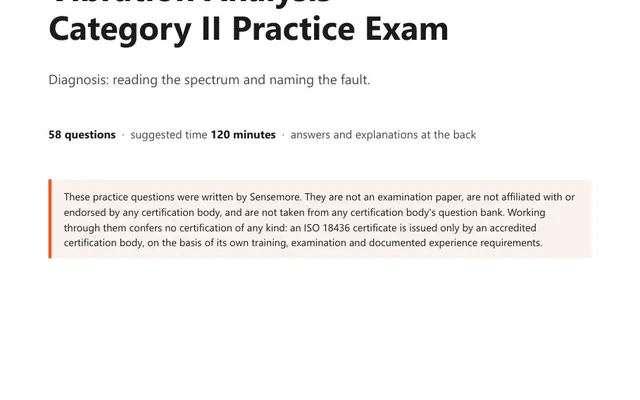
58 practice questions on vibration diagnosis, from fault signatures and phase to bearings, gears and resonance, each answer worked rather than lettered.