

Oil Analysis and Lubrication Training: Level 1
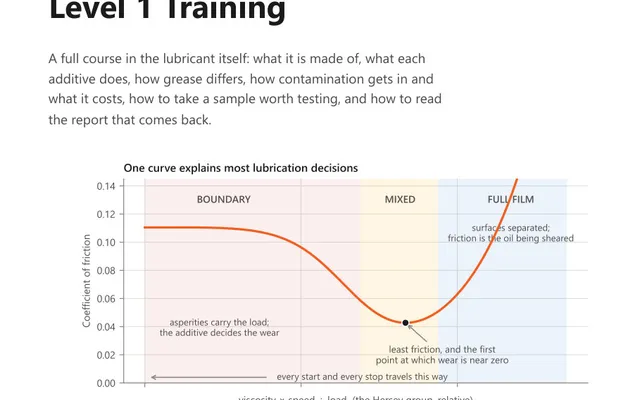
A 66-page course book on the lubricant itself, from the Stribeck curve to base oils, additives and grease, for the analyst who has to read a report.
Enter the particle counts a laboratory reported at 4, 6 and 14 micrometres and the calculator returns the three-number ISO 4406 code, the count range behind each digit, and how far the oil sits from a target you type in. The code compresses a particle count into three digits, and that compression is exactly what makes it easy to misread.
ISO 4406 reports cleanliness as three range numbers separated by slashes, such as 18/16/13. They are cumulative counts, which is how a particle counter reports them. The first covers every particle at or above 4 µm(c), the second every particle at or above 6 µm(c), and the third every particle at or above 14 µm(c). A particle big enough to be counted in the third number has already been counted in the first two.
Each channel answers a different question:
A range number is not a count. It is the label on a band of counts, and each band allows twice as many particles as the band below it. Two facts carry the whole scale:
All figures are particles per millilitre. A count reported per 100 millilitres has to be divided by 100 before any of this is done.
ISO 4406 itself is the authority on the band edges, and the standard is worth having in front of you if you set cleanliness targets. The doubling is a shortcut rather than the table, because the printed edges are rounded. A count within a few per cent of an edge has to be read off the standard, and above range number 16 the two part company by enough to move a borderline result by a whole code. At the very top of the scale the coding stops and the count itself is reported.
Because every step is a doubling, the ratio between two codes is two raised to the difference between them. One code is twice the particles, two codes is four times, three codes is eight times.
This is the arithmetic that gets lost when a report is skimmed. An oil at 20/18/15 against a target of 18/16/13 looks like a near miss written down, and it is four times the particle loading in every channel. A component life that scales with contamination does not treat those two oils as similar.
A hydraulic sample comes back at 6800 particles per millilitre at or above 4 µm(c), 2100 at or above 6 µm(c) and 250 at or above 14 µm(c).
Divide each count by the anchor of 10, then find the first power of two that reaches it:
The code is 20/18/15. Against a system specified at 18/16/13, every channel is two range numbers high, so the oil carries two to the power of two, or four times, the particle count the specification allows. Not slightly dirty. Four times over, three channels out of three.
The number the laboratory returns describes the sample, not the system, and most disagreements between two reports are disagreements about how the oil was taken rather than about the oil.
Draw the sample from a live line under pressure, upstream of the filter, with the machine at operating temperature and running. A sample taken from the bottom of a settled reservoir will read dirty because that is where the dirt has gone. A sample taken downstream of the filter reports on the filter and says almost nothing about the machine.
The counting method has its own blind spot. The usual automatic counter works by light extinction: the oil passes a laser one particle at a time and each particle’s shadow is sized and counted. A shadow does not say what cast it, so entrained air bubbles, water droplets and soft contaminants are all counted as particles, which is why a wet or freshly shaken sample can produce a code that no amount of filtration will improve.
Consistency beats correctness here. A sample point that is slightly wrong but always the same still produces a trend you can act on. A sample point that moves produces a series of unrelated numbers with a slash in them.
One code is a snapshot. The useful signal is the direction it moves in, and because the scale is logarithmic, a rise of a single range number is already a doubling of the particle load. A system that walks from 17 to 19 on the 14 µm(c) channel over three samples has quadrupled the coarse particles most likely to jam a valve, and it has done so while the report still looks like it is changing by ones.
It is three range numbers describing one oil sample. The first covers every particle at or above 4 micrometres per millilitre, the second every particle at or above 6 micrometres, and the third every particle at or above 14 micrometres. Each range number is the label on a band of counts, and each band holds twice as many particles as the one below it. The scale is anchored so that more than 5 and up to 10 particles per millilitre is code 10, and ISO 4406 itself is the authority on the band edges. The counts are cumulative, so a particle counted at 14 micrometres has already been counted in the other two.
Four times dirtier. Each ISO 4406 range number covers twice the particle count of the one below it, so a difference of one code is a factor of two, two codes is a factor of four, and three codes is a factor of eight. Reading the codes as if they were ordinary numbers makes a serious miss look like a rounding error, which is the single most common way the scale is misunderstood.
From a live line under pressure, upstream of the filter, with the system at operating temperature and running. A sample drawn from the bottom of a settled reservoir reads dirty because that is where the dirt has gone, and one drawn downstream of the filter reports how well the filter works rather than what is happening in the machine. Sampling from the same point every time matters more than which point is chosen.
Because the standard prints the doublings rounded rather than exact. The doubling is the rule worth carrying in your head, but ISO 4406 is the authority on the edges themselves. Software that computes a code from a power of two rather than from the published table will disagree with a laboratory report on borderline counts, and above code 16 the gap is wide enough to move a result by a whole code. Read a count that lands near an edge off the standard rather than off the shortcut.
They track different damage. The 4 micrometre channel counts nearly everything and follows the fine silt responsible for most wear. The 14 micrometre channel counts the coarser particles that jam valves and score surfaces, and most equipment specifications are written around it. The 6 micrometre channel sits between the two and tends to be the first to move when a filter starts to be bypassed rather than filtering.
The calculator gives you the number. These course books explain what the number means and how the measurement that produced it should be taken.
A 66-page course book on the lubricant itself, from the Stribeck curve to base oils, additives and grease, for the analyst who has to read a report.
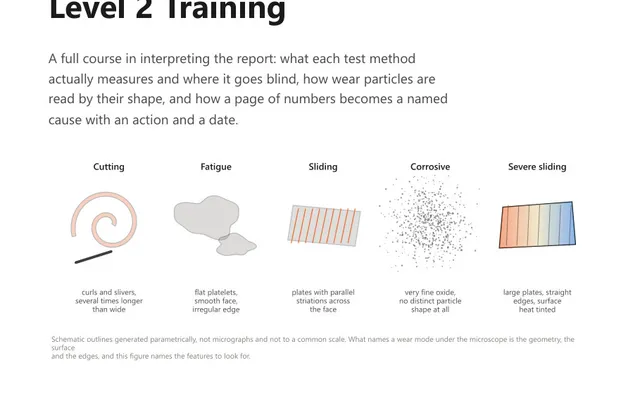
A 59-page course book on what each oil analysis test measures and where it fails, with the chapter on wear particle morphology that most books skip.
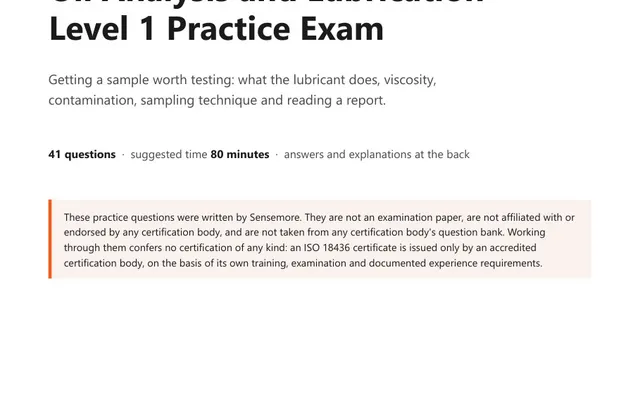
41 practice questions on the lubricant itself, from viscosity and additives to sampling and reading a report, each answer worked rather than lettered.