

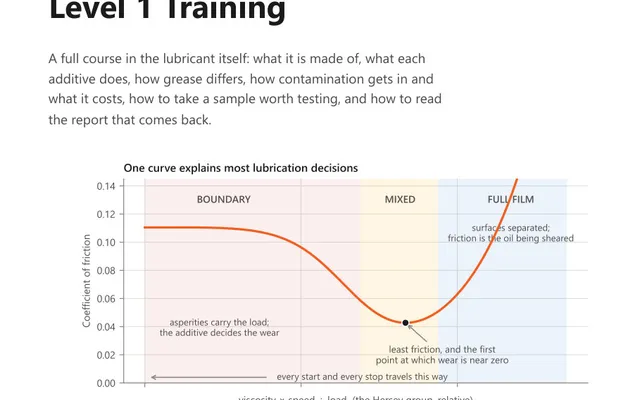
Oil Analysis and Lubrication Training: Level 1
A 66-page course book on the lubricant itself, from the Stribeck curve to base oils, additives and grease, for the analyst who has to read a report.
A bearing’s regrease quantity in grams is 0.005 times its outside diameter times its width, both in millimetres, and the interval is not a calculation at all: it comes from the bearing maker’s chart and is then shortened by heat, shaft orientation and contamination. The calculator does the quantity, works out the speed factor those charts are indexed on, and applies the condition factors to a base interval you bring with you.
With the outside diameter D and the width B in millimetres, the grease quantity G in grams is:
That is the whole of it. Neither the speed, nor the grease grade, nor the load enters. The bore does not appear either, which catches people out: the amount of grease a bearing wants follows the free volume inside it, and outside diameter times width is a good enough stand-in for that volume.
The figure refills the space a bearing needs without packing it. Over-greasing is not a harmless error made in the direction of safety. Grease that cannot escape is churned by the rolling elements, churning heats it, heat drives the oil out of the thickener, and the bearing then fails from the lubrication it was given rather than the lubrication it lacked. A bearing that is hot an hour after a grease round has usually had too much, and the fix is a relief path and a smaller charge rather than a thinner grease.
Two more numbers come straight from the dimensions, with the bore d in millimetres and the shaft speed n in rpm:
The speed factor has units of mm/min. What matters about it is that it is the axis every published relubrication chart is drawn against, because it stands for how hard the grease is being worked. A small bearing turning fast and a large one turning slowly can land on the same point of the chart and want the same interval.
The common slip is the mean diameter itself. It is the mean of the bore and the outside diameter, not the pitch diameter of the rolling elements and not the outside diameter on its own.
Relubrication intervals come from the bearing maker. They are published as a chart against the speed factor and the bearing type, and the type matters as much as the number: at one and the same speed factor, a ball bearing, a cylindrical roller bearing and a spherical roller bearing are given very different intervals, because they differ in how much they slide and how hard they work the grease. No general formula reproduces that, and a calculator that invented one would be borrowing authority it does not have.
So the base interval is an input. What gets applied to it is the part that is usually left out of a lubrication route.
Three factors multiply together:
The adjusted interval is the base interval multiplied by all three.
A bearing with a 60 mm bore, a 130 mm outside diameter and a 31 mm width, on a shaft turning at 1480 rpm. The maker’s chart gives a base interval of 4000 hours. The bearing runs at 85 degrees on a horizontal shaft in a clean, steady location.
Read the last line before anything else. Fifteen degrees of extra bearing temperature, which is well inside what a hot ambient or a blocked cooling path will give you, has taken half the life out of the grease. If the same bearing sat on a vertical shaft in a dusty, vibrating location, the combined factor would be 0.5 × 0.5 × 0.5, and the 4000 hour interval would be 500.
An interval is an estimate of when a bearing will want grease. Ultrasound tells you that it does. A rise of about 8 dB over the measurement point’s own baseline, with no change in the character of the sound, is the signature of a bearing short of lubricant, and it appears before the temperature does.
Greasing while watching that number is better than greasing to a date, because it tells you when to stop as well as when to start: the level falls back as the grease reaches the contact, and any further pumping is going into the housing rather than into the bearing. The calculated quantity stays useful as the ceiling. If the number has not come down by the time that many grams are in, the problem is the grease path, not the grease.
The usual quantity in grams is 0.005 times the bearing's outside diameter times its width, with both dimensions in millimetres. A bearing 130 mm across the outside and 31 mm wide therefore takes about 20 grams. The bore does not enter the calculation, because the grease a bearing wants follows the free volume inside it, and outside diameter times width stands in for that volume well enough.
The base interval comes from the bearing maker, read off their chart against the speed factor, which is shaft speed in rpm times the mean of the bore and the outside diameter in millimetres. That chart also depends on the bearing type, since the same speed factor means different things to a ball bearing, a cylindrical roller bearing and a spherical roller bearing. Operating conditions then shorten the base figure.
It is shaft speed in revolutions per minute multiplied by the mean diameter of the bearing in millimetres, and the mean diameter is the bore plus the outside diameter divided by two. Published relubrication charts are indexed on that product rather than on speed alone, because it stands for how hard the grease is being worked. A small fast bearing and a large slow one can share a point on the chart.
Above 70 degrees Celsius the interval halves for every 15 degrees, because grease life falls that fast with heat. A bearing running at 85 degrees therefore reaches half the interval its chart gives, and one at 100 degrees a quarter of it. Below 70 degrees the charted interval stands. Temperature is the strongest of the adjustments and the one most often missing from a lubrication schedule.
Grease that cannot escape from the housing is churned by the rolling elements, and churning heats it. Heat drives the oil out of the thickener, so the grease stiffens and stops feeding the contact. The bearing then runs hot and fails from the lubrication it was given rather than the lubrication it lacked. A bearing that is hot an hour after a grease round has usually had too much.
The calculator gives you the number. These course books explain what the number means and how the measurement that produced it should be taken.
A 66-page course book on the lubricant itself, from the Stribeck curve to base oils, additives and grease, for the analyst who has to read a report.
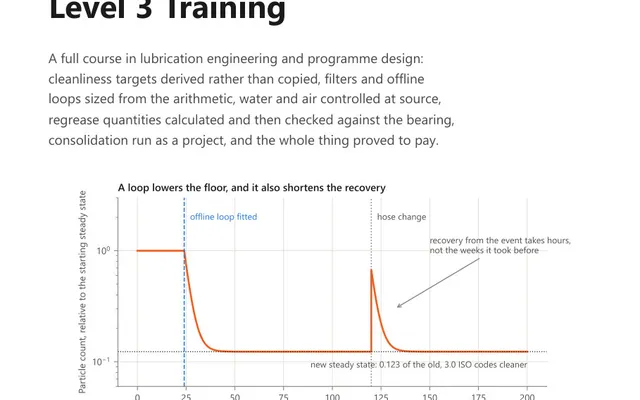
A 58-page course book on lubrication engineering: cleanliness targets, filter sizing, regrease quantity and varnish, worked for the machine at hand.

37 practice questions on lubrication engineering, from cleanliness targets and filter sizing to regrease intervals, each answer worked in full.