

Shaft Alignment Training
A 60-page course book that treats alignment as a calculation: offset, angularity, shim thickness and thermal growth, with the sign conventions worked.
Enter each machine’s material, the height from its feet to the shaft centreline and the temperature it runs at, and the calculator gives the rise of each shaft and the cold vertical offset the difference between them is worth. Cold alignment is not the target; it is the starting position that gets the pair in line once they are hot.
Growth is a length, a coefficient and a temperature rise multiplied together:
growth = height × expansion coefficient × (operating temperature − alignment temperature)With the height in millimetres and the coefficient in micrometres per metre per degree, the answer comes out in millimetres. For carbon steel that works out at roughly 12 micrometres per metre of height for every degree, which is a number worth carrying in your head as a sanity check on anything the calculator returns. A 400 mm centreline running 30 degrees above the temperature it was aligned at gives 0.4 × 12 × 30 micrometres, about 0.14 mm.
A pump that rises 0.21 mm is not a problem. A pump that rises 0.21 mm bolted to a motor that rises 0.08 mm is a 0.13 mm offset that appears an hour after start-up and stays there for as long as the machine runs.
That is why the calculator asks for both machines. The cold target is the negative of the difference: the machine that will grow more is set that much low, so that the two arrive level.
Two machines of the same material at the same temperature can still differ, because the heights differ. A tall motor and a short pump grow by different amounts from the same rise.
| Material | µm per metre per °C |
|---|---|
| Cast iron | 10.8 |
| Carbon steel | 11.7 |
| Stainless steel, austenitic | 17.3 |
| Brass | 18.7 |
| Aluminium | 23.1 |
Austenitic stainless expands about half as much again as carbon steel. A stainless process pump against a cast iron motor is the pairing that most often surprises people, because both look like metal and behave differently by nearly 60 percent.
Measure from the shim plane to the shaft centreline. The shim plane is the underside of the feet, where the shims go, because that is the surface that cannot move. Anything below it belongs to the baseplate and the foundation, and it is not what the temperature rise is acting on.
Nameplate shaft height is measured from the mounting surface of the frame. That is often the same plane, and it is not guaranteed to be. Where a machine sits on a subframe, on chocks, or on a raised pedestal, the two differ by exactly the amount that will make the answer wrong.
The alignment temperature is the metal temperature when the readings were taken, not the air temperature and not the weather. A machine aligned first thing on a winter morning in an unheated hall starts from a different place than one aligned at the end of a shift in the same hall.
The operating temperature is the metal temperature at the bearing housings once the machine has been running long enough to stop changing, which for a large machine can be several hours. Taking the reading too early understates the rise.
A cast iron pump with a shaft centreline 350 mm above its feet, running at 75 °C. It drives from a carbon steel motor whose centreline sits 280 mm above its feet and runs at 45 °C. Both were aligned at 20 °C.
The pump rises by 0.350 × 10.8 × 55 ÷ 1000 = 0.208 mm. The motor rises by 0.280 × 11.7 × 25 ÷ 1000 = 0.082 mm.
The pump is the stationary machine here and the motor is the one that moves, so the difference is 0.082 − 0.208 = −0.126 mm. The motor grows 0.126 mm less than the pump does. To arrive in line when hot, the motor is set 0.126 mm high when cold.
At 1480 rpm the working rule gives an acceptable offset of 0.074 mm and an excellent one of 0.037 mm, so 0.126 mm is well over three times the excellent figure and more than one and a half times the acceptable one. Aligning this pair to zero cold would leave them out of tolerance for every running hour, and no amount of care with the laser would show it.
The calculation assumes both machines reach a steady temperature and expand freely upwards. A machine held by tight pipework, sitting on a foundation that is itself warming, or heated more on one side than the other will not do what the numbers say.
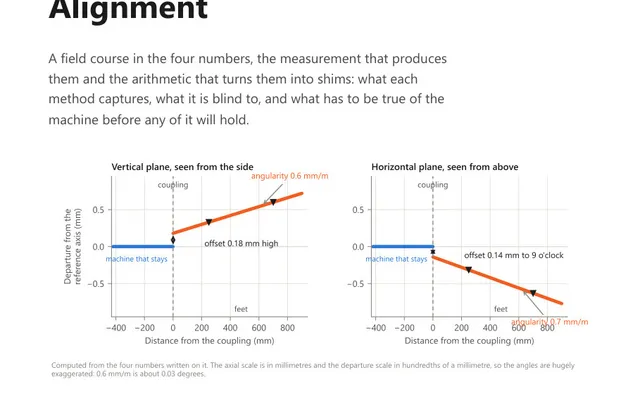
It also says nothing about sideways movement, and machines move sideways. A casing anchored at one end grows towards the other, so a hot pump can travel horizontally by as much as it rises, and the result is a horizontal misalignment that appears only once the machine is at temperature. Where the growth is large enough to matter vertically, it is large enough to matter horizontally too, and the horizontal part has to be measured rather than read off this page.
On anything critical, measure the running position instead. That means laser brackets left on through a heat-up, or proximity probes, or the old trick of aligning hot immediately after a shutdown and recording what changed. The calculation is the right starting point and the wrong final word.
Multiply the height from the shim plane under the feet up to the shaft centreline by the material's expansion coefficient and by the temperature rise. For carbon steel the coefficient is about 11.7 micrometres per metre for every degree Celsius. A machine with a 400 mm centreline height running 30 degrees above the temperature it was aligned at rises about 0.14 mm.
The vertical distance from the shim plane, meaning the underside of the feet, up to the centre of the shaft. Not from the floor, not from the top of the baseplate, and not the shaft height stamped on the nameplate, which is measured from the mounting surface of the frame. The feet are bolted down and cannot move, so everything above them is what expands upwards.
Because the alignment that matters is the one at operating temperature, and the readings are taken cold. If the two machines grow by different amounts, their shafts move relative to each other after start-up. Setting the cold offset equal and opposite to that difference means the pair arrives in line once hot. A machine set perfectly in line cold is misaligned every hour it runs.
Carbon steel is about 11.7 micrometres per metre per degree Celsius, cast iron about 10.8, austenitic stainless steel about 17.3, brass about 18.7 and aluminium about 23.1. The differences matter: a stainless pump body and a cast iron motor frame of the same height and the same temperature rise will not arrive at the same place, which is a common source of surprise on chemical duty.
Whenever the machine cannot grow freely. Tight pipework, a hot foundation, uneven heating from one side, or a casing restrained by its supports will all defeat the arithmetic, because the arithmetic assumes free vertical expansion at a uniform temperature. On critical machines the honest answer comes from measuring the running position directly, with laser brackets left in place or with proximity probes.
The calculator gives you the number. These course books explain what the number means and how the measurement that produced it should be taken.
A 60-page course book that treats alignment as a calculation: offset, angularity, shim thickness and thermal growth, with the sign conventions worked.

45 practice questions across shaft alignment and field balancing, from shim arithmetic to two-plane vector corrections, each answer worked in full.