

Infrared Thermography Training: Category II
A 57-page course book on turning a thermal image into a defensible measurement, with emissivity determined on the surface and the error budget worked.
Enter the reference temperature, the measured temperature and the load the equipment was carrying, and you get ΔT as measured, a projection of that rise to rated load as a range, and where the projection falls under the criterion your programme has adopted. Most disputed thermography calls turn on the second of those figures rather than the first.
An absolute temperature on a connection means very little by itself. A busbar sitting at 60 °C in a hot switchroom in August may be behaving perfectly; the same busbar at 60 °C at three in the morning in an empty building is another matter entirely. There are three comparisons available, and they are ranked rather than interchangeable.
Against an identical component under the same load. The matching phase, the neighbouring bearing, the adjacent tube in the same bank. This is the strongest evidence there is, because everything but the fault is held constant and most of the measurement error, which is shared between the two readings, cancels.
Against the same component’s own history. The same target, at the same load band, with the same settings, last quarter. Strong, and the whole reason a route is re-surveyed rather than surveyed once. It is also the only comparison available on equipment that has no twin.
Against ambient air. The weakest, because every loaded conductor is warmer than the air and knowing that tells you nothing about what this one ought to run at.
Choosing the wrong basis is one of the quickest ways to reach the wrong answer. A criterion written against a reference component cannot be applied to a rise over ambient. A 12 degree rise over the neighbouring phase and a 12 degree rise over room air are not the same finding at all. Where there is no identical component, say so in the report rather than falling back on ambient without comment, and recommend a repeat survey to start building a history.
Resistive heating goes with the square of the current, so a fault measured at part load is understating itself, and by a lot. A connection carrying half its rated current runs at roughly a quarter of the rise it would reach at full load. Because criteria are written for rated conditions, a reading taken at part load has to be projected before it can be placed against one:
ΔT at rated load ≈ ΔT measured × (100 / load %)ⁿ
The exponent is where the honesty lives. The pure resistive argument gives n = 2, but a real termination also loses more heat by convection as it gets hotter, so the exponent that actually applies is usually a little under two. This calculator returns both ends, n = 1.7 and n = 2, and the width between them is the real uncertainty in the projection.
Two things follow. Report the measured value first, with the current it was measured at, because that is the number that was actually observed. Then report the projection as a range, labelled as a projection: a projected number that later turns out wrong will otherwise be remembered as a measurement.
The projection is also why the load is a required field here rather than an optional one. A difference reported without the load it was taken at is the number somebody will compare against a criterion written for rated conditions, and they will do it whether or not the load was recorded.
The projection raises whatever measurement error came in with the reading to nearly the same power. At 30 percent load the multiplier is above eleven on the square law, so a two degree uncertainty on the surface becomes a twenty-two degree uncertainty in the result. At low load the temperature rise is small to begin with, which means the ratio of signal to error is at its worst exactly where the extrapolation is at its longest.
Many criteria also carry a minimum load below which they simply do not apply, which is one of the qualifications people skip. A survey at low load that found nothing has not found nothing; it has failed to look. Record the load, note that the survey should be repeated at a representative load, and come back rather than publish a number built that way.
Several bodies publish temperature-rise criteria for electrical inspection, and many sites adopt one and write it into their procedure. This page quotes none of them, deliberately. They differ from one another, they are copyrighted, and a priority that cannot be traced to a stated source is an opinion rather than a finding. What is worth knowing is how they are put together, because that is what tells you what your measurement has to supply.
What the rise is measured against. Usually an identical component under the same load, sometimes ambient, and the two are not interchangeable.
A small number of bands, each with a name, a recommended action and a timescale. The bands are what turn a number into a decision.
Qualifications, which are the part people skip: the minimum load for the criterion to apply, whether it covers devices as well as connections, and what to do when there is no reference component.
The calculator applies one commonly used shape of criterion so that it can place a reading somewhere. Those bands are an illustration of how the arithmetic lands, not a rule to apply and not a substitute for a document you can cite. Adopt a published criterion, name it and its edition in every report, and check its qualifications before applying it.
Severity is also not urgency. Severity is how far from normal the component is, judged against the criterion. Urgency is how soon somebody must act, and it depends on things the camera never saw: whether the circuit has a standby, what fails downstream, how long a spare takes to arrive, when the next outage is. A severe finding on a redundant feeder can wait; a moderate one on the only supply to a furnace cannot. They belong in the report as two separate lines.
A cable termination reads 52 °C. The matching phase beside it, carrying the same current, reads 38 °C. The feeder is running at 65 percent of rated current.
ΔT as measured is 52 − 38 = 14 °C, at 65 percent of rated current.
The current ratio is 100 / 65 = 1.54. On the square law, 1.54² = 2.37, giving 14 × 2.37 = 33.1 °C. Raised to 1.7 instead, 1.54 gives 2.08, and 14 × 2.08 = 29.1 °C.
So the report line reads: 14 K over the reference phase at 65 percent of rated current, projecting to roughly 29 to 33 K at rated load, assuming purely resistive heating, steady state and unchanged cooling. Both numbers belong in the report and the measured one comes first.
Nothing about the termination changes between the two figures. What changes is that a 14 degree difference nobody would prioritise turns into a projection worth ranking, and the criterion owner now has the load in front of them when they rank it.
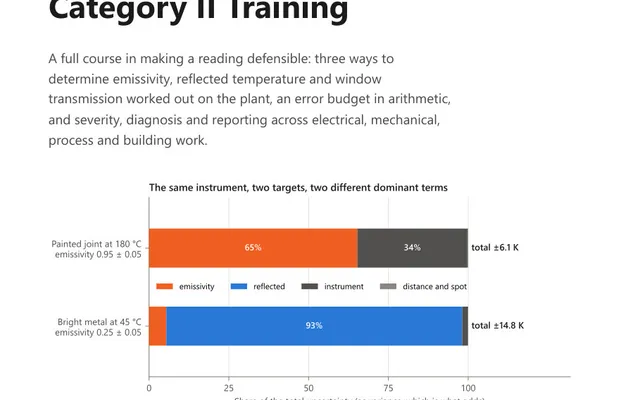
The reference and the target have to be the same material with the same surface, or the difference between them is emissivity rather than temperature. A shiny copper busbar next to a corroded one will read cold whatever it is doing, because bare bright metal emits only a small fraction of what an oxidised surface at the same temperature emits, and most of what the camera collects from it is reflection. Compare like with like, and where the surfaces genuinely differ, correct for that before subtracting one reading from the other.
The same caution applies to what the camera can resolve. A small terminal photographed from across a yard fills part of a single pixel, and the temperature reported for it is an average of the terminal and whatever sits behind it. That reading will be low, sometimes very low, and no criterion can repair it afterwards.
ΔT is the difference between the temperature of the component being inspected and a stated reference, not the absolute temperature of the component. There are three references and they are not equivalent: an identical component under the same load, usually the matching phase, then the same component's own history, then the ambient air at the equipment. Criteria are written around a difference because an absolute reading depends on room temperature, load and season, none of which say anything about the joint itself.
Multiply the measured ΔT by the ratio of rated current to the current actually flowing, raised to a power between about 1.7 and 2. Resistive heating goes with the square of the current, but a real termination also loses more heat by convection as it gets hotter, so the exponent that applies is usually a little under two. Report the result as a range and label it a projection, because a projected number that later turns out wrong will otherwise be remembered as a measurement.
An identical component under the same load whenever one is in the frame, because it holds everything but the fault constant and most of the measurement error cancels. The same point's own history comes next, which is why routes are re-surveyed rather than surveyed once. Ambient air is the weakest, since every loaded conductor runs warmer than the air. Where there is no identical component, say so rather than falling back on ambient without comment.
Because projecting to rated load raises the load ratio to a power near two, and it raises the measurement error with it. Below about 40 percent of rated current the real temperature rise is small, so the reading already carries a poor ratio of signal to error, and the projection then multiplies that error several times over. Genuine faults also stay barely warm at low load. Schedule the survey for a period of representative load.
The one it has adopted and written into its own procedure, cited by name and edition in every report. Several bodies publish temperature-rise criteria for electrical inspection and they do not agree with one another, so a band read off a document the site never adopted is an opinion rather than a finding. Read a criterion for its structure as well as its numbers: what the rise is measured against, what action and timescale each band carries, and the minimum load below which it does not apply at all.
The calculator gives you the number. These course books explain what the number means and how the measurement that produced it should be taken.
A 57-page course book on turning a thermal image into a defensible measurement, with emissivity determined on the surface and the error budget worked.
38 practice questions on making a thermal reading defensible, from determining emissivity to the error budget, each answer worked rather than lettered.
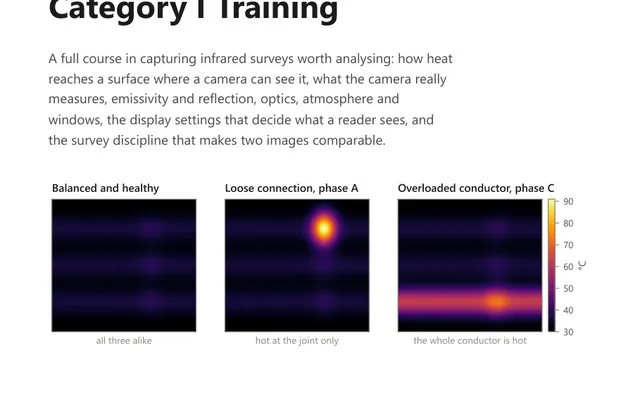
A 54-page course book for the thermographer who captures the images: how heat reaches a surface, emissivity, optics, and the conditions a survey needs.