

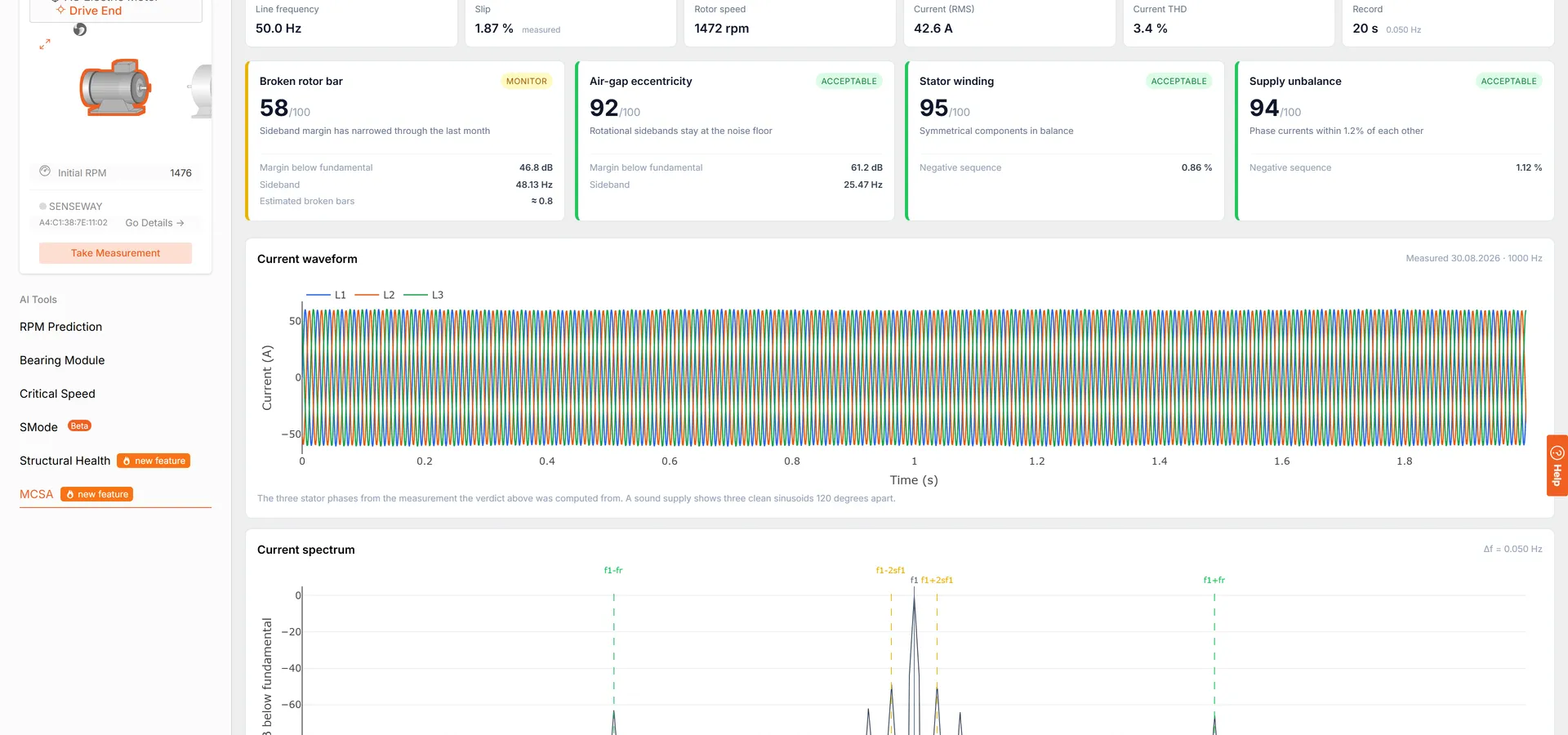
LAKE now reads the motor’s current the way it reads vibration. The new MCSA module detects broken rotor bars, eccentricity, stator winding problems, supply unbalance and bearing damage from the stator current, scores each fault type on every measurement, trends the scores over time, and refuses to declare a motor healthy on a recording that could not have proven it.
What It Detects
Each fault family gets its own score on every measurement, so a trend means one thing rather than a blend:
- Broken rotor bars, with an estimated bar count that is labelled as the estimate it is
- Static, dynamic and mixed eccentricity, separated rather than lumped together
- Stator winding problems, read from the symmetrical components of the three phases
- Supply unbalance
- Bearing damage as it appears in the current
Alongside the verdicts, the module reports current harmonic distortion, an envelope and Park vector view, and a load estimate, and it uses voltage channels when they are present.
Slip Is Measured, Not Assumed
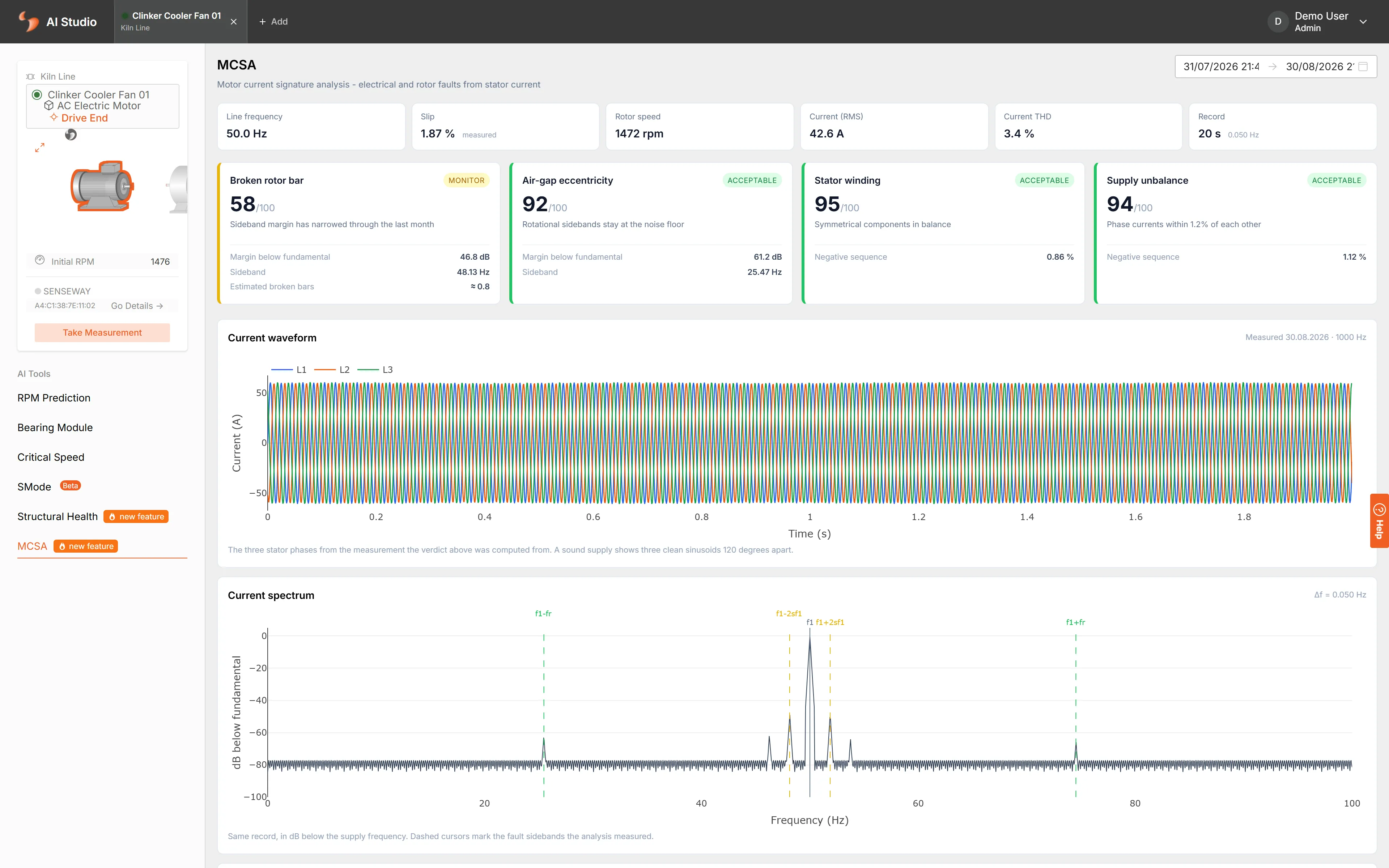
Every MCSA frequency depends on slip, and the nameplate speed lies under load. So the module recomputes slip from the spectrum itself, from where the lower sideband actually sits. That makes the analysis robust against nameplate errors, and produces an independent speed estimate that can be cross-checked against the platform’s RPM prediction.
Scored, Trended, Wired In
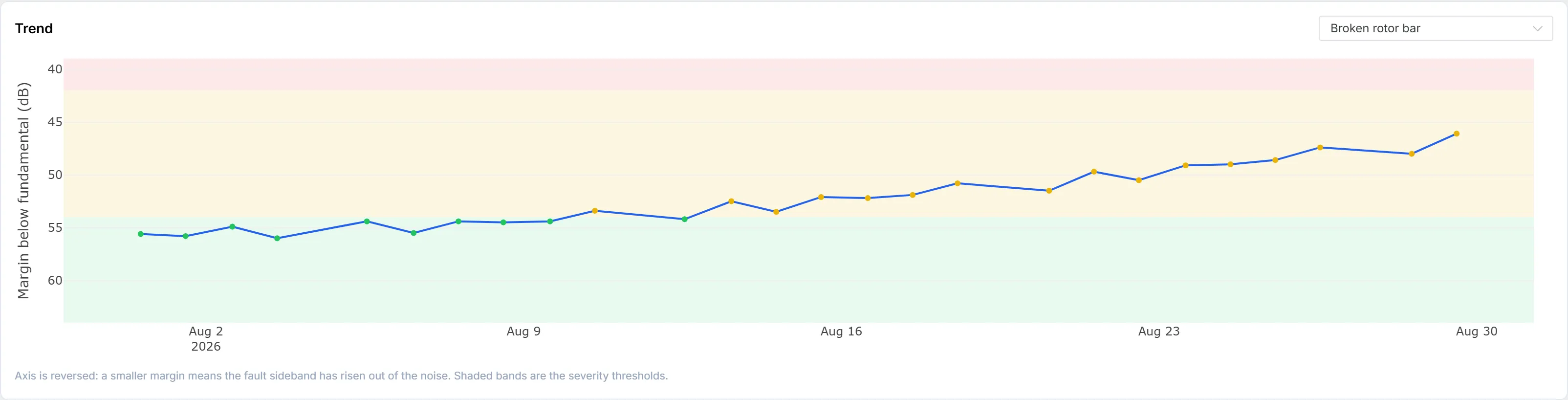
Every validated current measurement is scored automatically. The MCSA tab in AI Studio sits beside the bearing module, S-Mode and structural health, with score cards per fault type, severity badges, the operating point of the capture, and a trend chart with the severity bands shaded behind it. On the motor card, the pole count is now required and the rotor bar count unlocks the eccentricity analyses.
The results are not locked in a screen: the API serves the latest verdicts and their history per equipment, and two MCP tools, mcsa_get and mcsa_trend_get, put them in front of AI assistants, including the Reliability Agent.
Where to Find It
MCSA is in AI Studio, alongside RPM Prediction, the Bearing Module, S-Mode, Critical Speed and Structural Health. The measurement side builds on the energy, power quality and motor current release, and the method itself is explained in our MCSA article.
Frequently asked questions
What does the new MCSA module detect?
Seven fault families, each scored separately per measurement: broken rotor bars, static, dynamic and mixed eccentricity, stator winding problems read from the symmetrical components of the three phases, supply unbalance, and bearing damage as it appears in the current. Alongside the verdicts it reports current harmonic distortion, an envelope and Park vector view, and a load estimate, and it uses voltage channels when they are present.
Why measure current when we already measure vibration?
Because some faults live in the current first. A cracking rotor bar shows as sidebands around the supply frequency in the current spectrum before it shows in vibration, and supply unbalance and stator winding problems belong to the electrical side altogether. Current is the second window onto the motor: it confirms what vibration suspects and sees what vibration cannot.
Why does the module sometimes answer inconclusive instead of healthy?
Because clearing a motor is the expensive verdict. The sidebands that convict a rotor sit only a few hertz from the supply frequency, and how close depends on slip, so the recording length the verdict needs is computed per measurement. Confirming a visible fault takes a short record; declaring a motor clean requires resolving the closest sideband a loaded motor could produce. When the recording cannot support the verdict, the module says inconclusive rather than pretending, and the screen says what was missing.
What does the module need to run?
Three-phase stator current, recorded from the junction box by a Duck, with a long low-rate capture: the recommended profile is 20 seconds at 1 kHz, which is cheap to store. On the motor card, the pole count is required, and the rotor bar count unlocks the eccentricity analyses. Voltage channels are optional and used when present. Every validated current measurement is scored automatically.
Can the Reliability Agent and my own tools read the MCSA results?
Yes. The scores and trends are in the API per equipment, and two MCP tools, mcsa_get and mcsa_trend_get, expose the latest verdicts and their history to AI assistants, including the Reliability Agent, which weighs the electrical evidence next to vibration when it works a case.