

Field Balancing Training
A 56-page course book that works field balancing as vector arithmetic, on one plane and on two, for the analyst who has to correct a rotor in place.
Two plane balancing takes three runs, turns them into four complex influence coefficients, and solves a pair of simultaneous equations for the two correction masses. Every amplitude and phase reading is a vector, so the whole calculation is complex arithmetic, solved by Cramer’s rule.
A rotor long enough to sit in two bearings can carry a couple: equal unbalance at each end, half a turn apart. A couple produces no net force, so a single plane correction sees nothing to fix, and yet the bearings feel it as strongly as anything else. The usual sign is a correction that improves one bearing and makes the other worse.
The general case on a real rotor is dynamic unbalance, part static and part couple, needing two corrections at two axial positions. That is what three runs are for.
Run 1 records amplitude and phase at both bearings as found. Run 2 fits a known trial mass at a known angle in plane 1 and repeats both readings. Run 3 removes that mass, fits a trial mass in plane 2, and repeats again.
Removing the first trial mass is not housekeeping. The arithmetic assumes exactly one trial mass is on the rotor at a time, and a mass left in place during run 3 makes that reading describe both planes at once, corrupting every coefficient that follows.
Amplitudes must share one unit across all three runs, because the solution depends only on amplitude ratios and on the angles between them.
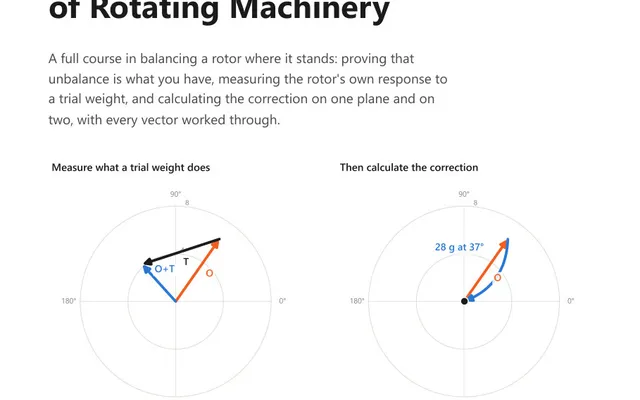
Write each reading as a vector. An amplitude A at phase angle θ becomes x = A cos θ and y = A sin θ. The as-found readings are A1 and A2, the run 2 readings B1 and B2, the run 3 readings C1 and C2. The trial masses T1 and T2 are vectors too: a mass at an angle, in the same convention as the phase.
What each trial mass did on its own is the vector difference:
Dividing each by the trial mass that caused it gives vibration per gram, as a magnitude and an angle together:
Those four numbers are the machine. Write them into the record with the reference mark and the direction angles increase in: next year’s balance on the same rotor at the same speed can start from them.
U1 and U2 have to cancel both as-found readings at once:
With the determinant D = H11·H22 − H12·H21, Cramer’s rule gives both directly:
All of it is complex multiplication and division, so each answer arrives as a magnitude, the mass, and an angle, where to put it.
D is the part worth watching. It falls towards zero when the two planes move the two bearings in nearly the same proportion, leaving the two equations to describe the same thing twice. No unique pair of masses then solves them, the arithmetic still returns an answer, and that answer is enormous and wrong.
The calculator refuses to print it once the determinant drops to about a millionth of the size of its own terms. The cure is physical rather than numerical: a larger trial mass, or trial masses placed where the two planes act differently on the two bearings. A near zero determinant is a statement about the geometry of the job, not about the arithmetic.
A second and softer warning covers a different failure. A trial run that changes the combined reading at the two bearings by less than about a tenth of the combined as-found amplitude sits inside the noise of a hand held measurement, so the direction it implies is close to arbitrary. The determinant can be healthy and the answer still worthless: fit a heavier trial mass and run it again.
Mass angles and phase angles must be measured in the same rotational direction, from the same reference mark, in all three runs. Most instruments read phase lag, which increases against rotation, so mass angles are normally stepped off against rotation as well. Nothing in the arithmetic can detect which convention is in use; angles come back in whichever one they went in as, and mixing the two misplaces both correction weights by an amount that is entirely predictable and useless.
Three runs, with a 10 g trial mass at 0 degrees used in each plane in turn.
| Run | Bearing 1 | Bearing 2 |
|---|---|---|
| 1, as found | 7.166 at 77.48° | 3.379 at 50.07° |
| 2, 10 g at 0° in plane 1 | 11.17 at 58.22° | 5.209 at 61.12° |
| 3, 10 g at 0° in plane 2 | 6.484 at 88.73° | 6.489 at 90.72° |
Subtracting the as-found vectors leaves the effect of each trial mass: E11 = 5.00 at 30°, E21 = 2.00 at 80°, E12 = 1.50 at 200°, E22 = 4.50 at 120°. Dividing by 10 g at 0 degrees gives the four coefficients per gram: H11 = 0.500 at 30°, H21 = 0.200 at 80°, H12 = 0.150 at 200°, H22 = 0.450 at 120°.
Solving the pair returns 12.0 g at 225.0 degrees in plane 1 and 8.00 g at 69.99 degrees in plane 2. The readings were generated from a known unbalance of 12 g at 45 degrees and 8 g at 250 degrees. A correction opposes the unbalance it cancels, so the right answer is half a turn away from each, and recovering exactly that pair tests the whole chain of complex arithmetic against something known independently of it.
Look at the coefficients rather than the answer. A gram in plane 1 does two and a half times as much at bearing 1 as at bearing 2, and the two planes act 170 degrees apart at bearing 1 but only 40 degrees apart at bearing 2. That asymmetry is what keeps the determinant healthy, and no amount of care with the readings rescues a rotor that lacks it.
Three. The first records amplitude and phase at both bearings as found. The second adds a known trial mass at a known angle in plane 1 and repeats both readings. The third removes that mass, fits a trial mass in plane 2, and repeats again. Those three runs yield four influence coefficients, which is exactly the number an unbalance in two planes acting on two bearings requires.
They are the four complex numbers that describe how each correction plane moves each bearing. One coefficient is the vibration a gram in plane 1 produces at bearing 1, another is what the same gram does at bearing 2, and the remaining pair says the same for plane 2. Each has a magnitude and an angle, and both halves are needed: the magnitude sizes a correction and the angle places it.
Because the arithmetic assumes exactly one trial mass is on the rotor at a time. A mass left in plane 1 during the third run makes that reading describe both planes together, so the change attributed to plane 2 is not what plane 2 did. Every coefficient calculated afterwards inherits the error, and the corrections it produces look reasonable while being wrong in both planes.
Usually that the determinant of the coefficient matrix has gone towards zero, which happens when both trial masses move the two bearings in nearly the same proportion. The two equations then describe the same thing twice and no unique pair of masses solves them. The cure is physical rather than numerical: a larger trial mass, or trial planes that act differently on the two bearings.
In the same rotational direction as the phase readings, and from the same reference mark, in every run. Most instruments read phase lag, which increases against rotation, so mass angles are normally stepped off against rotation as well. No arithmetic can detect which convention is in use, and solved angles come back in whichever one went in, so mixing the two misplaces both correction weights.
The calculator gives you the number. These course books explain what the number means and how the measurement that produced it should be taken.
A 56-page course book that works field balancing as vector arithmetic, on one plane and on two, for the analyst who has to correct a rotor in place.
45 practice questions across shaft alignment and field balancing, from shim arithmetic to two-plane vector corrections, each answer worked in full.
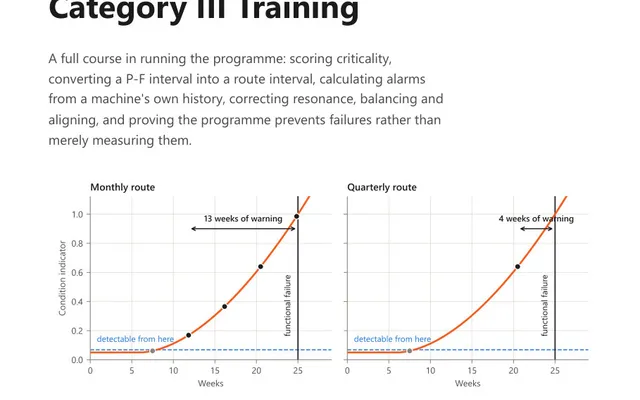
A 56-page course book on running the programme: criticality scoring, the P-F interval, and alarms calculated from the machine's own history, not a table.