
Vibration analysis training teaches the skill of diagnosing faults in rotating machinery from vibration data, and ISO 18436 is the standard that certifies that skill at four levels, from CAT I to CAT IV. Certification requires classroom training, documented field experience and an exam together. This guide explains what the levels mean, who genuinely needs the training, and how AI-assisted analysis has changed the calculation.
If you are new to the subject, start with what vibration analysis is and keep the vibration glossary open for the terms.
What Is ISO 18436?
ISO 18436 is the international standard that defines the qualification and assessment of condition monitoring and diagnostics personnel. The part relevant to vibration divides analyst competence into four categories and defines, for each, the training content, the experience requirement and the examination framework.
The certificate is issued not by the standard itself but by certification bodies accredited to it. You take the training, sit the exam and document your field experience; when all three conditions are met, the certificate is issued in your name. One detail matters more than it seems: the certificate belongs to the person, not to the company. When a certified analyst leaves, the competence leaves with them.
The CAT Levels, I Through IV
In practice, the four levels come down to this:
| Level | What it means in practice |
|---|---|
| CAT I | Collects single-channel data to predefined procedures and compares results against preset alarm limits. |
| CAT II | Selects measurement parameters, diagnoses common fault types from the spectrum, recommends corrective action. |
| CAT III | Designs and manages the whole program, resolves complex cases with advanced techniques, directs CAT I and II personnel. |
| CAT IV | Applies all techniques at an advanced level, is the final authority on the hardest cases including resonance and structural problems, develops methodology and training. |
Each level builds on the previous one: moving up requires more classroom hours, a longer experience record and a new exam. The large majority of practitioners hold CAT I or CAT II; CAT III and above are the small group who design programs and take the difficult cases.
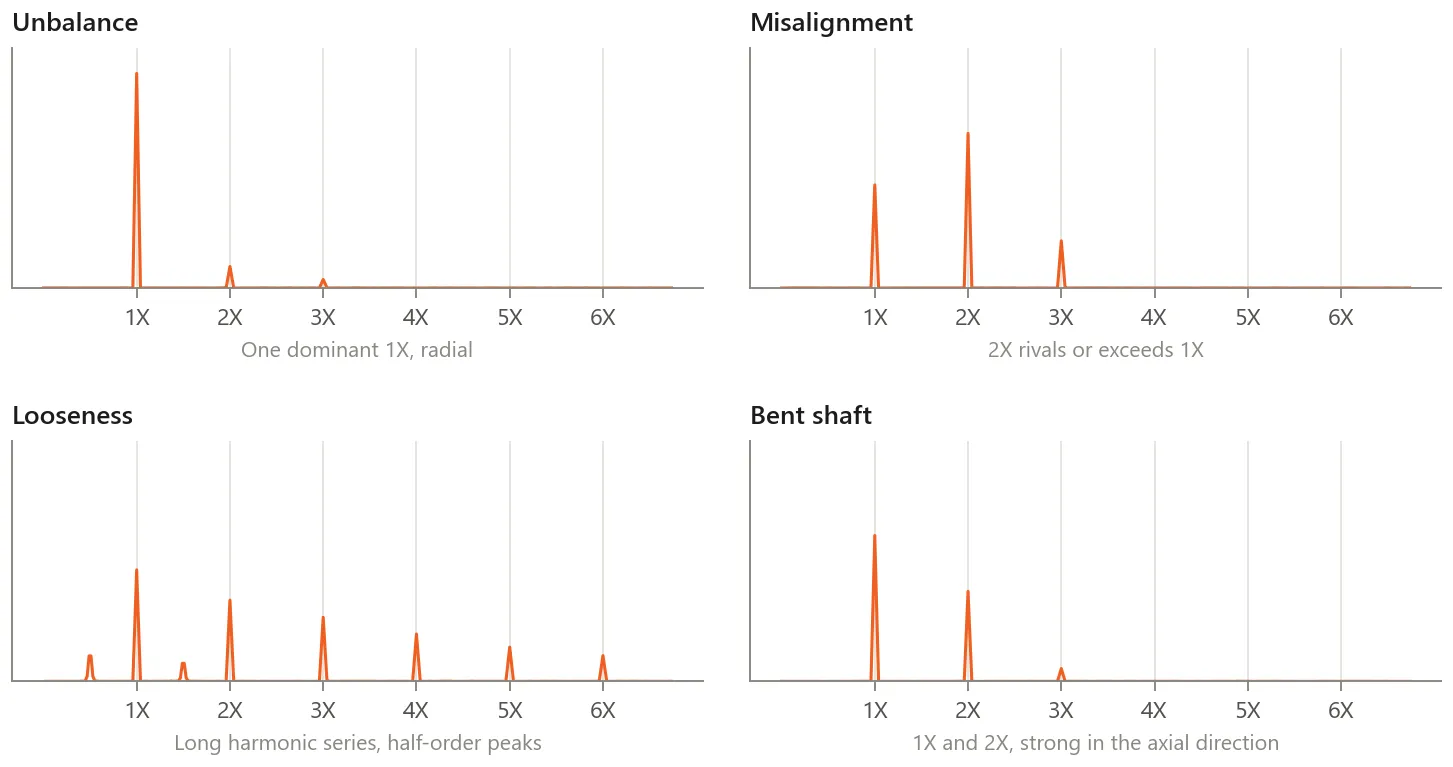
The step from CAT I to CAT II is visible in that picture. Collecting the data and comparing it against a limit is one job; looking at four spectra of similar amplitude and saying which one is unbalance and which is looseness is a different one. What separates the diagnoses is not how large the peaks are but which orders of running speed carry the energy, and in which direction the measurement was taken.
Study the material, then find out where you stand
Reading a description of the levels is not the same as knowing which one you are at. We wrote a study book and a practice exam for each category. The books teach the material, each figure computed from the physics it illustrates; the exams tell you what you can already handle, with a worked explanation behind every answer.
| Level | Study book | Practice exam |
|---|---|---|
| Category I | Taking measurements worth analysing | 25 questions |
| Category II | Reading the spectrum, naming the fault | 30 questions |
| Category III | Running the programme | 25 questions |
| Category IV | The hardest cases | 20 questions |
All of it is our own material, written from the physics. None of it is accredited training, none of it is affiliated with any certification body, and none of it confers certification. What it will tell you is which level’s material you can already handle and which you cannot, which is the useful thing to know before paying for a course.
Beside them sit the calculators: bearing defect frequencies, ISO 20816 severity, FFT resolution, balance quality and the rest. They are open, they need no sign-up, and each one prints the formula it uses.
What the Training Actually Gives You
The honest answer: less than you expect, and more.
Less, because the spectrum patterns learned in the classroom rarely look as clean in the field as they do in the textbook. A CAT II analyst coming back from the course builds the real part of the expertise over the following years, wrestling with their own machines’ data.
More, because the real value of the training is not the memorized patterns but the discipline it instills: that a measurement must be taken with the right parameters, that a single reading is not a verdict, that a diagnosis demands evidence. That discipline holds no matter which tools you use. And in some industries, customer contracts and audits require certified personnel; there the certificate is a commercial necessity with no substitute.
The clearest example of why that discipline matters is a bearing fault, which in a raw spectrum is often not visible at all:
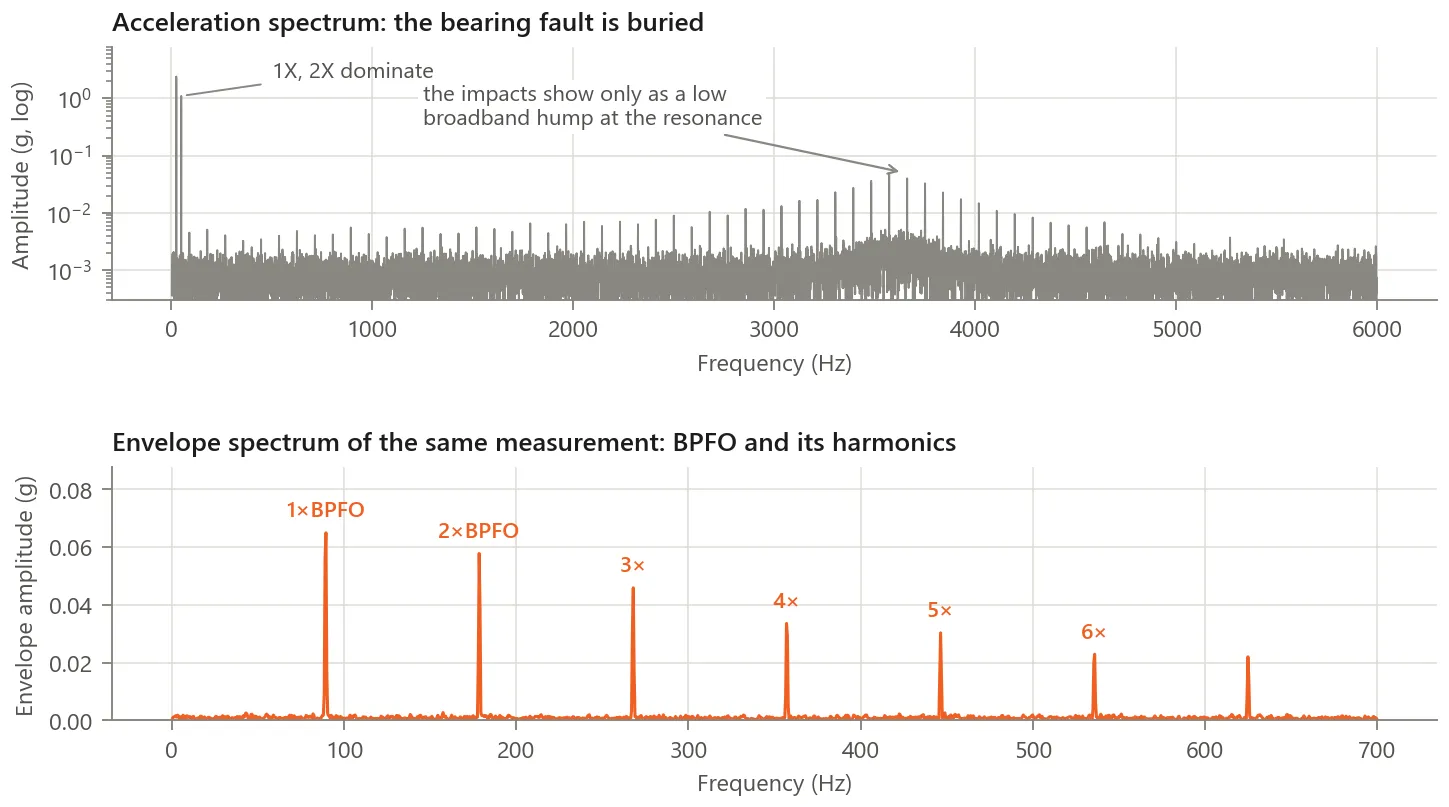
Both pictures come from the same measurement. In the first, the fault sits three decades below the running-speed peaks, low enough to look like noise; in the second, after envelope processing, the bearing’s outer race frequency and six harmonics are unmistakable. Knowing that the second picture exists, when to ask for it and how to read what comes back is exactly what a course teaches and what a checklist cannot.
What Awaits You After the Course: Measurement Volume
Here is the problem the course brochures do not mention: even a mid-sized plant has hundreds of measurement points, and once continuous monitoring is in place they produce new data every day. Reviewing one spectrum properly takes an analyst minutes. The arithmetic is unforgiving: a single analyst cannot look at more than a small fraction of what is produced.
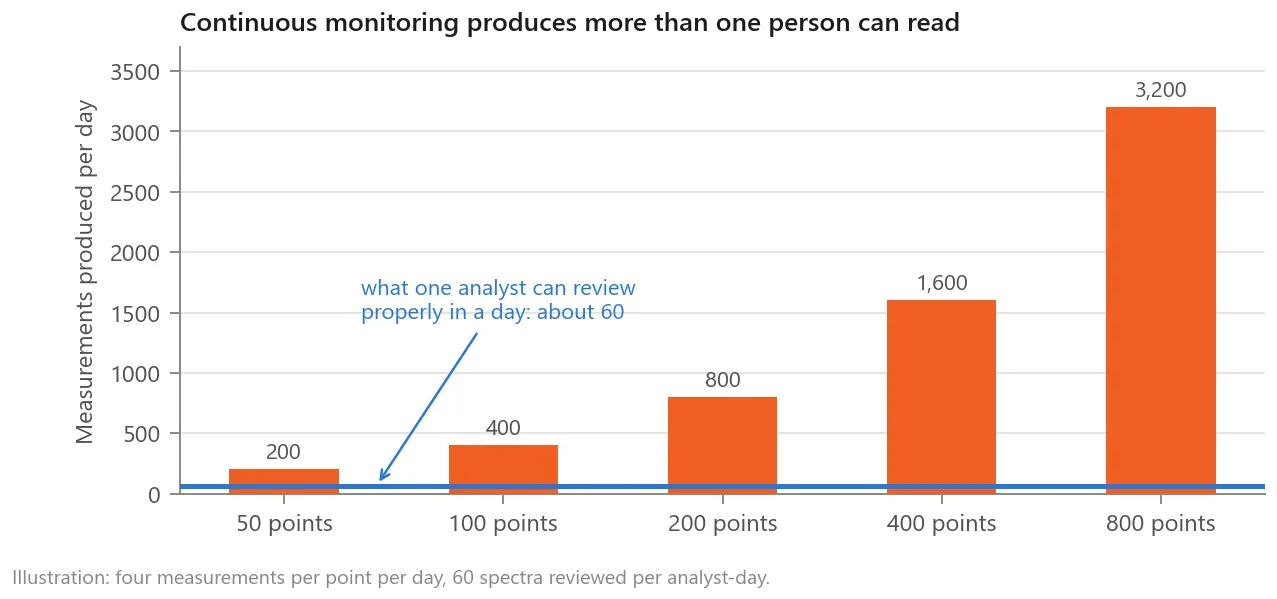
In practice this ends in one of two familiar situations. Either the analyst only looks at points that have alarmed, and faults growing below the alarm threshold slip past; or reviews are put on a calendar, and a fault progresses between two rounds. The scarce resource is not analysis expertise; it is the number of measurements the expertise can reach.
And the faults that hide below an alarm threshold are precisely the ones worth catching early:
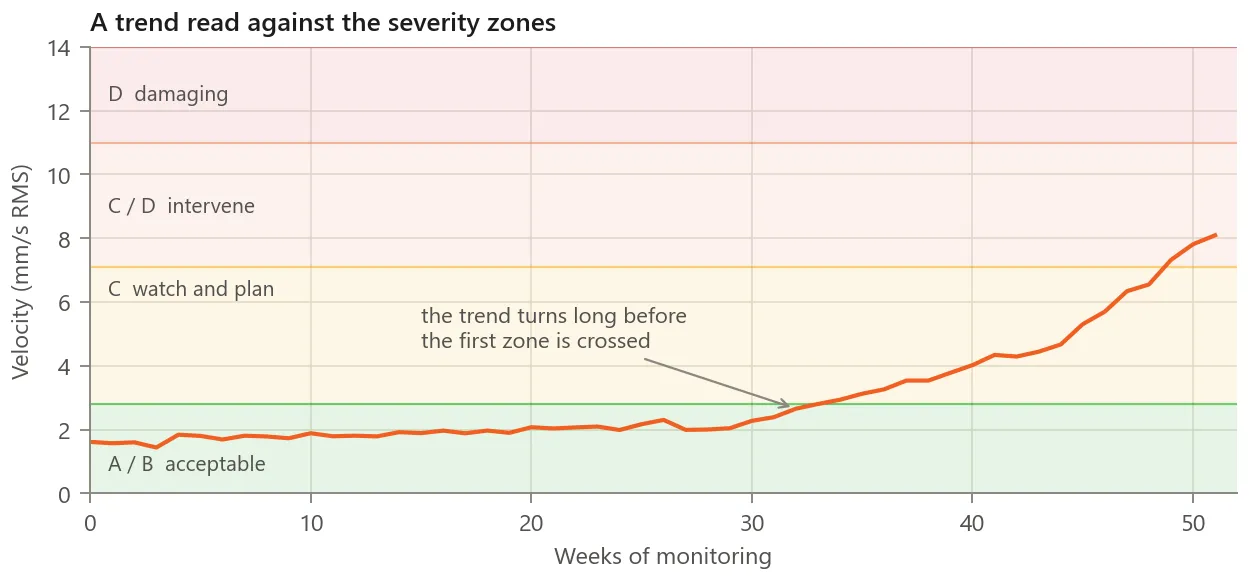
This machine turned upward around week thirty while still sitting comfortably inside the acceptable zone, and did not cross a threshold until week forty-four. An alarm-driven review finds it in week forty-four. A review that reads the trend finds it in week thirty, and the difference between those two dates is the entire value of a predictive program.
Analysis Is No Longer a One-Person Job
This bottleneck is where AI genuinely earns its place in this field. The Sensemore Reliability Agent works a case in the order an experienced engineer would: it checks structure before blaming mechanics, compares against a month ago instead of judging a single reading, follows every suspicion until it is confirmed or eliminated, and presents the diagnosis together with its chain of evidence. It proposes the action; the decision to open a work order stays with a person.
The connection to the training question is this: the agent does not tire, does not skip, and applies the same rigor to every measurement. The number of spectra a person can review in a day is limited; the agent has no such limit. If your team has a certified analyst, the agent removes the routine screening load and frees that expertise for the hardest cases. If it has none, the team can work with diagnoses and evidence without knowing how to read a spectrum; the answers are written for the person responsible for the machine, not for a specialist.
Training or Platform: Which Is the Right Question?
They are not rivals; what is wrong is framing the question as a binary choice. The right question is: which capability do you need, when, and in whom?
Investing in training is the right call when your contracts or audits require certified personnel, when you sell condition monitoring as a service, or when you want to give a lasting foundation to an engineer who will own the program for years. Note that the cost of that discipline is not only the course fee; the time the person spends in training and exam preparation, and the wait for the experience requirement to accumulate, are part of the bill.
The platform is the right call when there is no analyst on staff and no short-term prospect of growing one, when the number of monitored points exceeds what one person can cover, or when you want your existing analyst spending time on hard cases rather than routine screening. Let us be plain: the platform does not earn anyone an ISO 18436 certificate. What it delivers is not the certificate but the outcome the certificate was always a proxy for: catching faults early.
The strongest setup is the combination: a team with the fundamentals leaves the analysis volume to AI and does its own part better, which is machine knowledge, prioritization and the decision.
How to Start
The order matters, and most teams get it backwards: training first, data second. We suggest the reverse, because the best learning material is your own machines’ data.
- Set up monitoring first: put sensors on your critical machines and let data accumulate in the platform. How measurement parameters are chosen is covered in this guide.
- Learn the fundamentals as a team: download the Vibration Analysis Pocket Guide we prepared, covering measurement quantities, severity assessment and the common fault patterns.
- Work diagnoses with the agent: read its chain of evidence on every finding. That is a small training course run on your own data, repeated daily.
- Tie the training decision to data: after a few months it is far clearer where the program is heading, who needs which level of training, and whether certification is commercially required at all.
Training is valuable, and in the right person it is a lasting investment. But it is no longer the precondition for catching faults early; today the fastest path is to set up monitoring, hand the analysis volume to AI, and spend the expertise where it makes the real difference: the decision.
Frequently asked questions
Is ISO 18436 certification mandatory?
It depends on your situation. In some industries, customer contracts or audits require condition monitoring work to be performed by certified personnel; in that case certification is a commercial requirement, not a preference. Where no such requirement exists, the underlying goal of catching faults early can be reached without it: modern platforms carry most of the analysis load, and the team learns on its own machine data.
What is the difference between CAT I and CAT II?
CAT I is the data collection level: single-channel measurements taken to predefined procedures and compared against preset alarm limits. CAT II is the first diagnostic level: the analyst selects measurement parameters, diagnoses common fault types such as unbalance, misalignment, looseness and bearing wear from the spectrum, and recommends corrective action. For the person running a program, CAT II is the level that makes the practical difference.
Can you build a predictive maintenance program without a trained vibration analyst?
Yes. Sensors collect measurements continuously, the platform produces severity assessments and fault scores automatically, and AI-assisted analysis takes over spectrum interpretation. What the team must bring is not spectrum-reading expertise but knowledge of its own machines and the ability to evaluate a proposed action. Learning the fundamentals still helps; it is simply no longer a precondition for starting.
Will AI replace the vibration analyst?
It takes over most of the analysis work, not the decision. AI reviews every measurement without skipping and with the same rigor each time, processing many times the number of spectra a person can review in a day. Approval of actions, prioritization and machine knowledge stay with people. For a certified analyst this is a multiplier rather than a threat: the routine screening load disappears and the expertise goes to the hardest cases.
How long does vibration analysis training take?
It depends on the level. CAT I and CAT II courses typically consist of several days of intensive classroom training followed by an exam, and certification additionally requires documented field experience. The training hours and the experience requirement both increase at higher levels. The exact requirements are set by the accredited program of the certification body issuing the certificate.