
Oil analysis certification is split across several bodies rather than one: ICML issues MLT, MLA, LLA and MLE, STLE issues CLS and the Oil Monitoring Analyst certifications, and ISO 18436-4 covers field lubricant analysis inside the condition monitoring series. They overlap heavily in subject matter and differ in requirements and recognition. This guide explains which is which, what the material actually covers, and the limitation in standard test packages that lets machines fail while their reports look calm.
Who Issues What
The schemes are commonly confused, and MLA and MLT in particular are often attributed to the wrong body.
| Certification | Issued by | Aimed at |
|---|---|---|
| MLT I and II | ICML | Technicians responsible for lubricating machines correctly |
| MLA I, II and III | ICML | Analysts interpreting oil analysis results |
| LLA I and II | ICML | Laboratory analysts performing the tests |
| MLE | ICML | Engineer-level programme design |
| CLS | STLE | Broad lubrication specialist competence |
| OMA I and II | STLE | Oil monitoring analysts |
| ISO 18436-4 categories | Accredited certification bodies | Field lubricant analysis within condition monitoring |
Where a customer, insurer or auditor names a scheme, that settles it. Where nobody does, pick by which body of knowledge matches the work: lubricating machines well and interpreting laboratory reports are different jobs.
What Makes This Discipline Difficult
Not the chemistry. Two things: the sample, and knowing what each test cannot see.
The sample decides everything downstream
A laboratory reports what was in the bottle. If the bottle does not represent the machine, every number on the page is authoritative and wrong, and nothing in the report reveals it. Samples are taken from a live, turbulent zone upstream of the filter, with the machine at operating temperature, through a permanently fitted valve that has been flushed, into a clean bottle opened at that moment, and labelled with machine hours, oil hours and top-up history, without which the laboratory cannot separate a machine wearing fast from oil that is simply old.
Every test has a size window
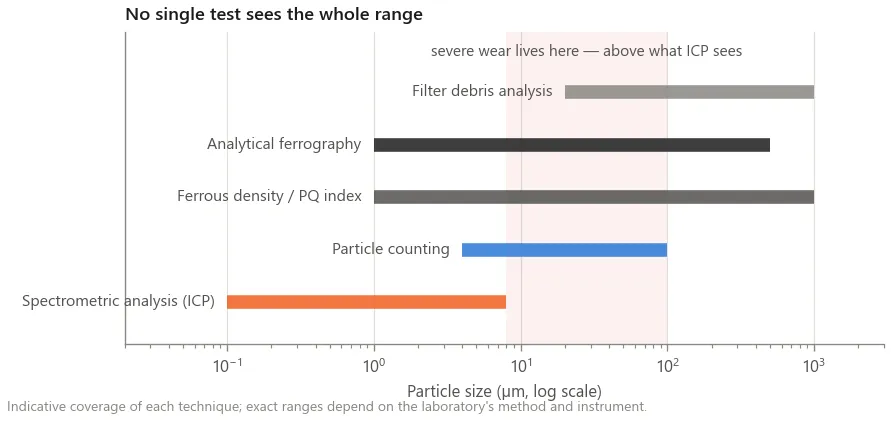
This is the part that catches programmes out. Spectrometric analysis by ICP is the backbone of most routine packages, and it measures small particles well and large particles poorly, because large particles are not fully broken down in the plasma.
Normal rubbing wear produces fine particles, which ICP sees. Severe wear, the kind that precedes a failure, produces much larger particles, which it substantially under-reports.
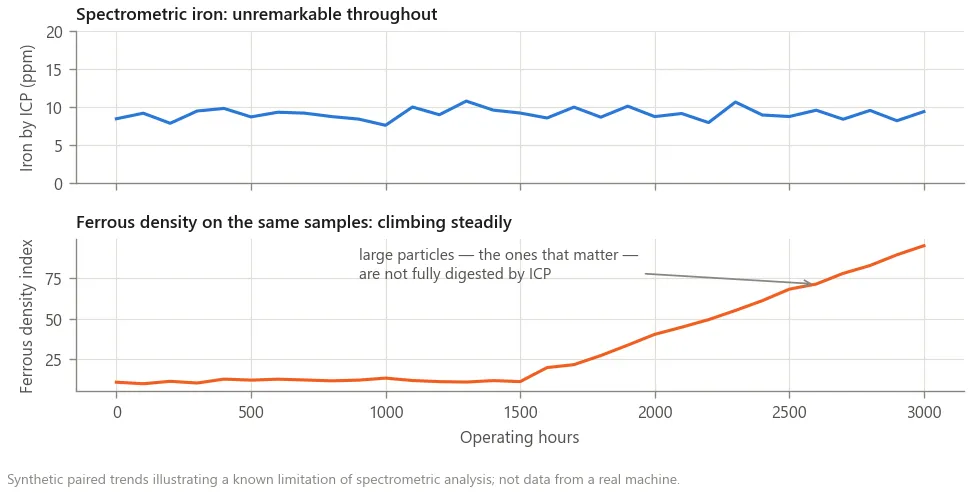
A machine shedding large ferrous debris can therefore sit under a perfectly unremarkable elemental trend. The pairing above is a specific and serious signature, and it is invisible unless both measurements are in the routine slate. That is the argument for including a ferrous density measurement: it responds to ferrous material at any size, covering exactly the range where ICP goes quiet.
Read Fitness, Then Contamination, Then Wear
A report answers three questions, and reading them in causal order rather than chasing whatever is flagged red is what separates interpretation from reaction.
| Question | Tests | What a change means |
|---|---|---|
| Is the lubricant still fit? | Viscosity, acid number, additive elements | The oil is degrading, or it is not the oil you think it is |
| Is it contaminated? | Water, particle count, silicon, coolant markers | Something is getting in, and it will cause wear |
| Is the machine wearing? | Wear metals, ferrous density, ferrography | Material is leaving a component |
Degraded oil causes contamination; contamination causes wear. Reacting to a wear metal without asking what caused it treats the symptom and leaves the cause running, which is how the same finding recurs every few months while everyone counts it as a monitoring success.
The Trend Beats the Limit
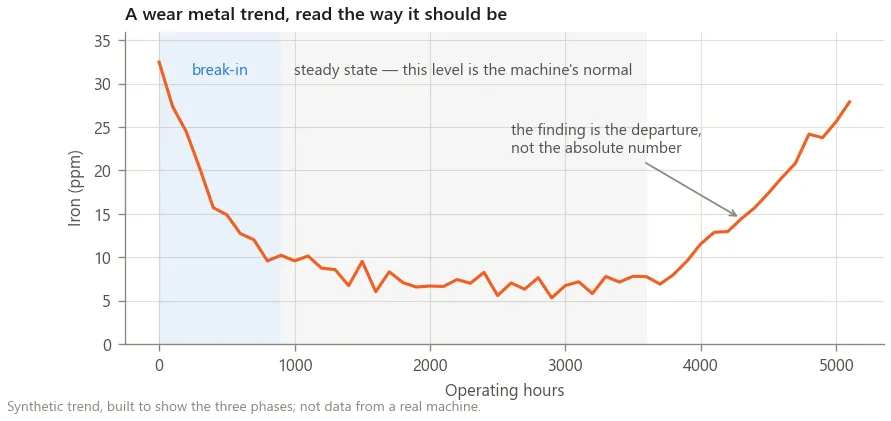
High readings during break-in are expected. The middle section establishes what normal is for this machine. The finding is the departure from that level, which arrives well before any generic limit is crossed. It is the same principle that governs vibration alarms, for the same reason: published limits describe a class of machine, and the individual machine’s own steady state is far more sensitive.
Most of the Value Is Not in the Testing
The dominant failure mode in lubricated machinery is contamination, and contamination is prevented by storage, handling, filtration and sealing rather than detected by analysis. A rigorous testing programme feeding a badly run oil store spends its budget observing the consequences of its own practice.
The ingress routes, roughly in the order they matter: reservoir breathers venting ambient air on every thermal cycle, top-up practice with new oil that is often dirtier than the machine’s target, worn seals and open hatches, drums stored outdoors upright with water pooling on the head, and maintenance work itself. Fitting desiccating breathers and filtering new oil on receipt are usually the two cheapest large improvements available.
Study the Material, Then Find Out Where You Stand
We wrote a study book and a practice exam at three levels. The books teach the subject with the figures computed rather than drawn; the exams tell you what you can already handle, with a worked explanation behind every answer.
| Level | Study book | Practice exam |
|---|---|---|
| Level 1 | Getting a sample worth testing | 25 questions |
| Level 2 | Interpreting the report | 20 questions |
| Level 3 | Running the programme | 15 questions |
All of it is our own material. None of it is accredited training, none of it is affiliated with ICML, STLE, ISO or any other body, and none of it confers certification. What it will tell you is which parts of the subject you already own, which is the useful thing to know before paying for a course.
The whole Field Series covers vibration analysis and thermography alongside oil analysis, because the strongest findings a plant produces are the ones two independent technologies agree on. The ISO 4406 cleanliness code calculator and the viscosity at temperature calculator are free to use and ask for nothing.
Frequently asked questions
Who issues the MLA and MLT certifications?
ICML, the International Council for Machinery Lubrication, issues the machinery lubrication certifications: MLT for technicians, MLA for machinery lubricant analysts, LLA for laboratory lubricant analysts and MLE at engineer level. They are frequently misattributed to STLE, which runs its own separate scheme including CLS and the Oil Monitoring Analyst certifications. Both are distinct from ISO 18436-4, which covers field lubricant analysis within the condition monitoring series.
Which oil analysis certification should I take?
It depends on the job and on who is asking. MLT suits someone responsible for lubricating machines correctly; MLA suits someone interpreting laboratory reports; the STLE certifications are well recognised in lubricant supply and laboratory work; ISO 18436-4 fits a condition monitoring programme that already works in that series. Where a customer, insurer or auditor names a scheme, that decides it. Where nobody does, choose by which body of knowledge matches the work.
What is the biggest blind spot in a standard oil analysis package?
Large particles. Spectrometric analysis by ICP is the backbone of most routine packages and it under-reports particles above roughly eight micrometres, because they are not fully broken down in the plasma. Normal rubbing wear produces fine particles that it sees well; advanced wear produces large particles it largely misses. A machine can therefore be shedding serious debris under an unremarkable elemental trend, which is why a ferrous density measurement belongs in the routine slate.
Where should an oil sample be taken from?
From a live, turbulent zone where the oil is well mixed, upstream of the filter and downstream of the components you care about, ideally through a permanently fitted sampling valve so the point is identical every time. Not from the bottom of the reservoir, which collects water and heavy debris and gives an unrepresentative result, and not from a drain during an oil change unless that is specifically what you want to know about.
Does oil analysis replace vibration analysis?
No, and the two are complementary rather than overlapping. Oil analysis generally sees the cause of a lubrication-related failure, whether contamination, water ingress, additive depletion or the wrong lubricant, while vibration analysis sees the mechanical consequence once damage has begun. A finding both technologies support is as strong as condition monitoring gets, and it also tells you what to fix: replacing a bearing without addressing the water ingress that killed it buys the same failure again.